Downwind (2025) a Chamber Opera in One Act.
Libretto by Demian Chavez Galvan
Commissioned by the Butler Opera Center
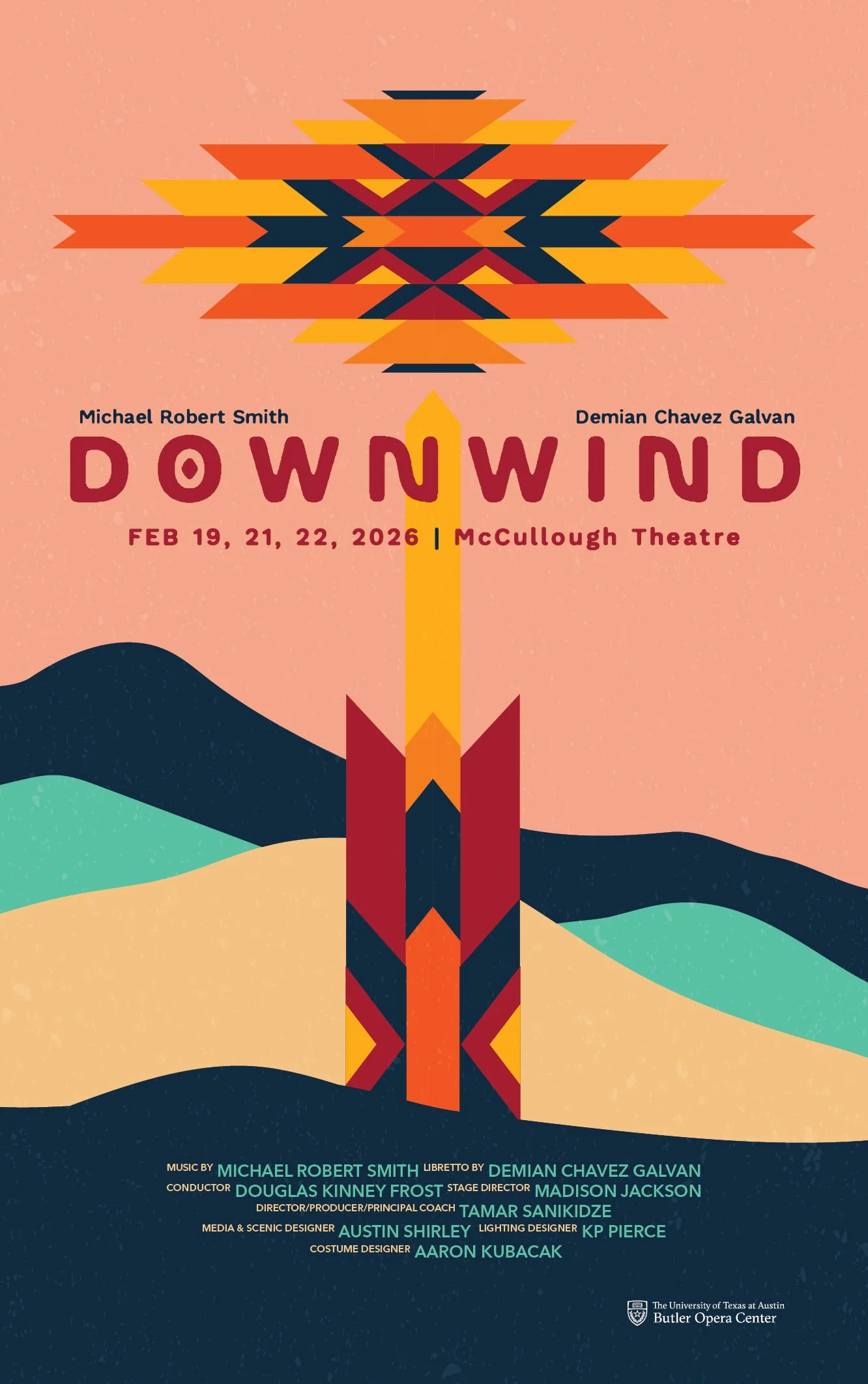
Premiered February 19, 21, and 22, 2026 at the McCullough Theatre in Austin, TX
Douglass Kinney Frost, Principle Conductor.
Duration: 75:00
Cast
Enrique, Tenor Ofelia, Soprano Teresa, Soprano Eduardo, Bass
Instrumentation
Flute (doubling Piccolo and Alto Flute) Oboe (doubling English Horn) Bb Clarinet (doubling Bass Clarinet) Bassoon (doubling Contrabassoon) French Horn Percussion Electronics Piano (doubling Melodica) Violin I Violin II Viola Violincello Double Bass SATB Chorus
Story
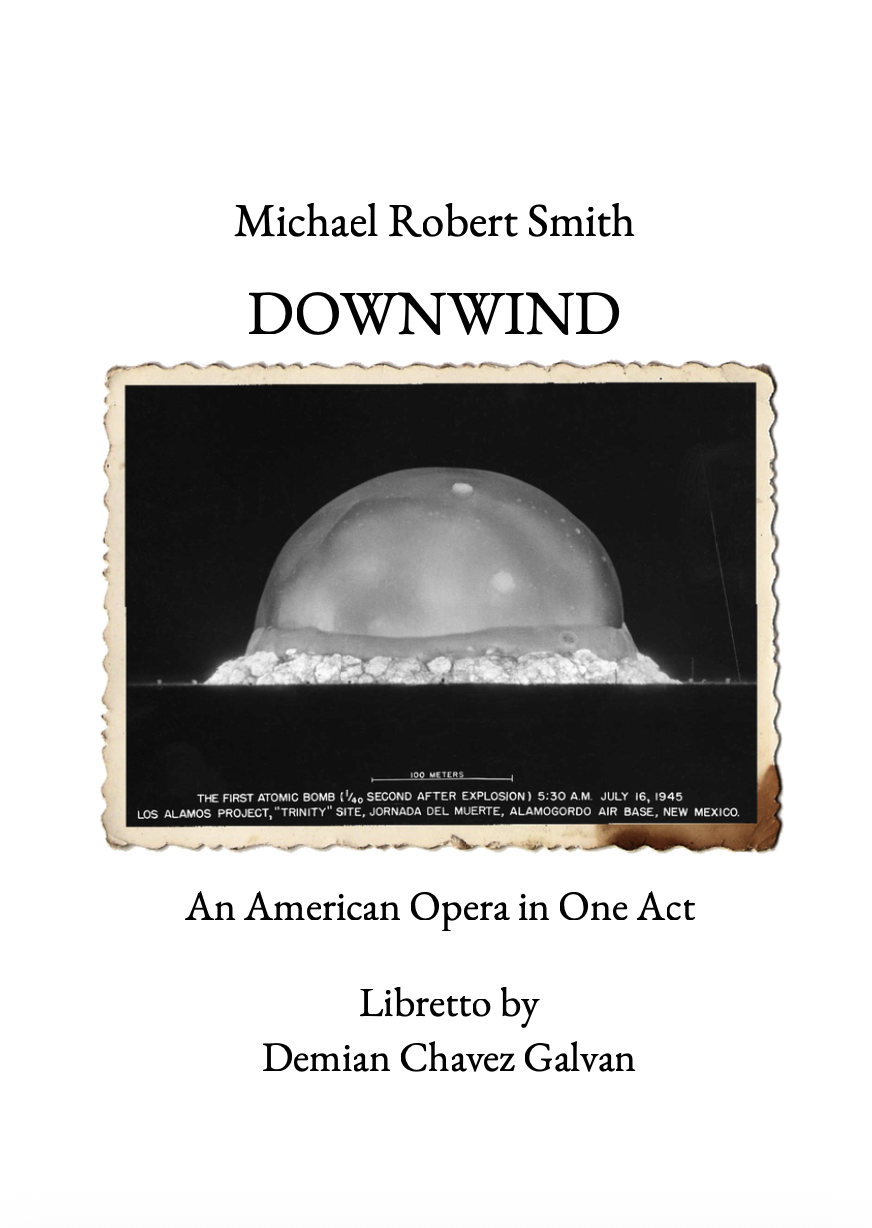
On July 16, 1945 at 5:29 am, the atomic age began with the detonation of the first nuclear weapon at the Trinity Test Site in the state of New Mexico. In the nearby town of Carrizozo, the unknowing Mendoza family watches as the sky explodes into a blinding light.
The fictional Mendoza family takes center stage in Downwind. Inspired by affidavits collected by the Tularosa Basin Downwinders Consortium and their members, we follow the consequences of the fallout of Trinity on the Mendozas. The story plays out in reverse chronological order starting with the death of the last surviving member of the family in 1990 to that fateful morning of July 16, 1945.
Downwind is dedicated to Tina Cordova, Paul Pino, and Bernice Gutierrez
‘Synopsis
PLACE: Carrizozo, New Mexico
TIME: Dusk to Dawn, 1990 to 1945
1990: Enrique Mendoza is dying. On the last night of his life, his father sings him to sleep.
1979: Ofelia Mendoza is dying. Enrique, her hardheaded brother, takes the news poorly.
1961: Teresa Mendoza is dying. Enrique and Ofelia, her children, come to care for her.
1945: Eduardo Mendoza is living. On a day like any other, he waits for the sun to rise.
BEFORE AND BETWEEN: The myths of the Mescalero Apaches come to life.
Sources
Teresa’s prayer in Scene III is adapted from Mi Canto de Hoy (My Song of Today, 1894), a poem by St. Thérèse of Lisieux, French Carmelite nun and patron saint of the terminally ill.
Eduardo’s lullaby in Scenes I & IV is adapted from Los álamos de plata (The silver cottonwoods, 1919),a poem by Spanish writer Federico Garcia Lorca, from his Libro de Poemas (Book of Poems, 1921).
The Prelude & Interludes are adapted from Chiricahua and Mescalero Apache Texts (1938), a collection of myths compiled by American linguist and anthropologist Harry Hoijer.
The myths adapted for the Interludes were contributed by Chiricahua Apache scout and Spanish–American war veteran Lawrence Mithlo (1862 – 1938) of the Fort Sill Apache Tribe.
These myths were first spoken in Chiricahua Apache, a Southern Athabaskan dialect closely related to Mescalero Apache, Navajo, and Western Apache. There are about 1,000 speakers of Chiricahua living today in the American Southwest, mostly within the Mescalero Apache Tribe and Reservation.
Note by Demian Chavez Galvan